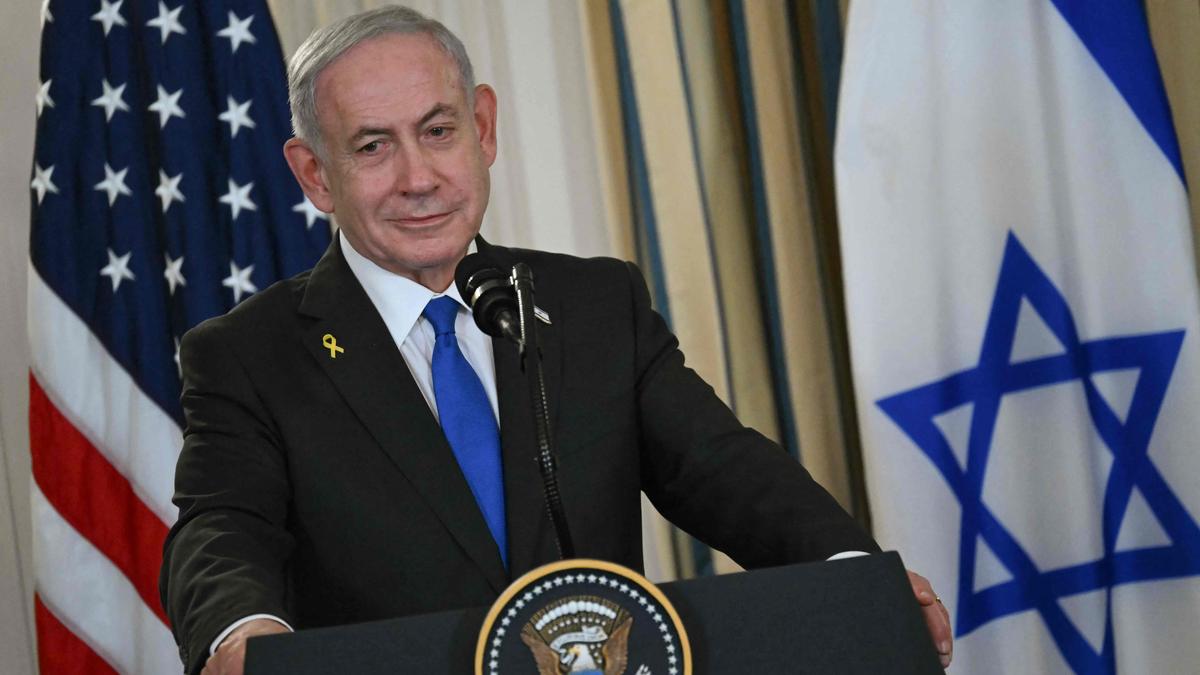

‘For decades, Israel has benefited strategically from the perception of Iran as the principal source of instability in West Asia’
| Photo Credit: AFP
The signing of a United States-Iran peace memorandum offers a rare opportunity to reduce tensions in one of the world’s most volatile regions. After decades marked by sanctions, proxy wars, covert operations, and periodic military confrontations, even a tentative framework for reconciliation between Washington and Tehran represents a significant diplomatic achievement. Yet, the prospects for transforming this memorandum into a permanent agreement depend not only on the willingness of the U.S. and Iran to compromise. They depend equally on whether Israel is prepared to accept a regional order in which Iran is no longer treated as a permanent enemy.
Israel’s long opposition
No country has done more over the past three decades to oppose U.S.-Iran rapprochement than Israel. Successive Israeli governments have portrayed Iran as an existential threat and have consistently sought to prevent any normalisation of relations between Tehran and Washington. While Israeli leaders justify this position in terms of national security, the persistence of their opposition suggests broader political and strategic motivations.
The historical record is revealing. The 2015 Joint Comprehensive Plan of Action (JCPOA) placed stringent restrictions on Iran’s nuclear programme and subjected it to one of the most intrusive inspection regimes ever implemented. International nuclear experts broadly agreed that the agreement significantly reduced the risk of Iran acquiring a nuclear weapon. Yet, Israel remained vehemently opposed to it.
What made Israel’s position particularly striking was that it opposed an agreement designed precisely to address the threat it claimed to fear most. The episode demonstrated that Israeli objections extended beyond the nuclear issue itself. What Israel appeared unwilling to accept was the broader implication of the agreement: the gradual reintegration of Iran into a regional order that Israel sought to dominate but would find it impossible to do if Iran was a part of it.
For decades, Israel has benefited strategically from the perception of Iran as the principal source of instability in West Asia. The Iranian threat has long served as a justification for deeper military cooperation with the U.S., expanding security ties with Arab states, and the diversion of international attention from the Palestinian issue. As long as Iran remained centre stage, scrutiny of Israeli policies in the occupied Palestinian territories remained secondary.
From Iran to Palestine
A successful U.S.-Iran rapprochement would fundamentally alter this equation. If Iran ceased to be seen as the region’s primary threat, international attention would inevitably shift back to the Palestinian issue — including the occupation, settlement expansion in the West Bank and the humanitarian crisis in Gaza. This concern has become more acute since the Gaza war, which has severely damaged Israel’s international standing and intensified global scrutiny of its policies towards Palestinians.
At the same time, the regional mood has shifted. Arab governments that once viewed confrontation with Iran as a strategic necessity have increasingly embraced de-escalation. Saudi Arabia’s restoration of diplomatic relations with Iran in 2023 signalled a growing recognition that endless rivalry has imposed enormous political and economic costs on the region. Many Arab states, especially in the Gulf, now see stability and economic development as more urgent priorities than perpetual confrontation with Tehran — a point driven home strongly by the recent conflict.
Israel finds itself increasingly at odds with this emerging regional consensus. While it continues to advocate a strategy centred on containing and isolating Iran, much of West Asia appears to be moving toward cautious engagement. A permanent U.S.-Iran agreement would reinforce this trend and further weaken the logic of confrontation.
Israel’s choice ahead
Nevertheless, Israel retains significant influence over U.S. policy through the American Israel Public Affairs Committee (AIPAC) and other channels, strong congressional support and deeply institutionalised security ties. This influence has often shaped American approaches towards Iran. The danger is that Israeli leaders may again seek to derail diplomacy through political pressure, demands for unattainable concessions or military actions that raise regional tensions and undermine negotiations. Israel’s continued strikes in Lebanon despite repeated rebukes from U.S. President Donald Trump are a clear indication of the preferences of Israel Prime Minister Benjamin Netanyahu’s government.
The fundamental issue, therefore, is whether Israel can adapt to a West Asia in which its security is no longer based on the isolation of Iran but on a broader framework of regional coexistence. The Netanyahu government’s record offers little reason for optimism, having consistently favoured military action over diplomatic compromise.
The future of the U.S.-Iran peace memorandum may therefore depend a great deal on Israel’s willingness to accept a changing regional landscape. If Israeli leaders continue to view any U.S.-Iran understanding as inherently unacceptable, they may succeed in obstructing a permanent agreement. But in doing so, they would be confronting a broader regional movement towards de-escalation at a moment when West Asia desperately needs it, potentially leading to Israel’s further isolation both regionally and internationally.
Mohammed Ayoob is University Distinguished Professor Emeritus of International Relations, Michigan State University, and the author most recently of From Regional Security to Global IR (2024)
Published – June 17, 2026 12:08 am IST
Leave a Reply