The Cockroach Janta Party’s movement has highlighted the political urgency for reforming the economy to create more employment for India’s youth. Fixing the education system alone will not solve the unemployment problem. The basic structure of the economy must be reformed.
China and India, the only two countries in the world with populations exceeding one billion, have the greatest need for meaningful employment. If citizens are not fully employed, and incomes of masses do not rise, their economies cannot grow. China has done much better than India in this regard; the per capita income of Chinese citizens has risen roughly eight times faster than Indians’ in the last 30 years.
India’s leaders find themselves in the middle of conflicting trends. First, they are pushing ahead with reforms for ‘ease of doing business’; diluting the rights of workers to organise; and weakening environmental protection. Second, they are promoting the wide-spread application of Artificial Intelligence (AI) to improve ‘productivity’ (and other benefits) in agriculture, industry, health and education, with productivity defined, purely in economic terms, as more output with less human input. Third, they also see the need to change the pattern of growth and increase employment elasticity. Employment elasticity is the amount of meaningful employment created with each unit of GDP growth, in which India has been a laggard since the liberal market economic reforms of the 1990s.
Since India has the largest population of youth in the world, its economic growth should have the highest employment elasticity. However, the increased adoption of AI will only make it worse.
The China model
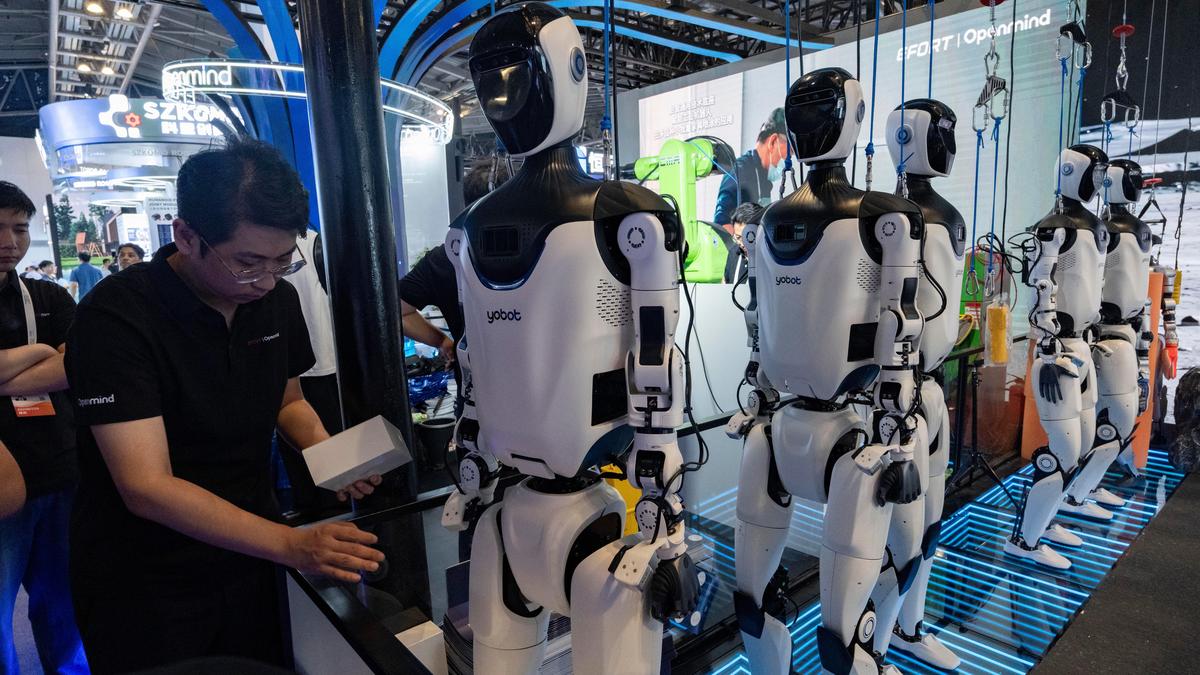
China has invested billions to become an AI superpower and has raced to integrate the technology across a range of industries. By 2024, more than two million robots were already working in Chinese factories. And in Beijing, Shanghai and Shenzhen, Meituan, the nation’s largest food delivery service, has experimented with using small autonomous robots to deliver food. But China’s advances in AI have run headlong into a growing problem: anxiety over the workers who could be displaced.
China’s political and economic history reveals that, despite being an authoritarian country, the Chinese government is very attentive to what people are thinking and saying on the Internet. History has taught them that another revolution will form if disenchanted and educated youth rise along with the disgruntled workers and peasants. They know they must respond.
Unemployment has been increasing in China. The unemployment rate for migrant workers rose to 5.7% in March this year, which has been the highest in nearly three years for China, while youth unemployment stood at 16.3% in April. Moreover, 70% of unemployed young people are university graduates, with older laid-off workers facing prolonged periods of joblessness.
However, Chinese courts have been swift to act. A court ruled in May that a tech company had illegally laid-off a worker after replacing him with AI software. Another ruled that, “the development of artificial intelligence technology should be applied to liberating labour, promoting employment and improving people’s livelihood”. And yet another ruled that “companies that benefit from technology must, at the same time, adopt social responsibilities and protect worker rights”.
China’s Ministry of Human Resources and Social Security announced in January that it would roll out policies to address the impact of AI on jobs, including targeted support for key industries. In June, the State Council issued a plan on implementing an “employment-first” strategy for the 2026-2030 period. Party officials have proposed sweeping government interventions such as requiring employers to offer training to help workers adapt to an AI-centric job market.
The Chinese government’s ‘people-first’ ideology has served China’s economy and its people well. China’s leaders have remained socialists; they have always put the needs of common citizens, and the stability of China’s society, above economists’ demands for deregulation of markets and prices, especially with respect to labour, food, education, health, and housing.
The road ahead for India
Indian income levels must rise rapidly — in agriculture, manufacturing, and services. The government has added ‘ease of living’ to ‘ease of doing business’ as the purpose of the reforms required for India to become ‘Viksit Bharat’ by 2047. To make it a reality, it will have to put more teeth into its policies to increase employment and incomes, and stave off the negative impacts that AI will have on employment. Policies must require that employers take more responsibility for training their own workers; they must be restrained from laying them off.
New policies must put workers’ rights ahead of capitalists’ rights, as China has done. India’s labour market reforms, with the four labour codes, are directed to improve ‘ease of doing business’, which is undoubtedly necessary. However, the ‘ease of doing business’ must now become subordinate to the ease of living and earning for all citizens.
India’s leaders would do well to learn from China’s leaders on how to navigate this moment in history. The rights of all workers must be firmly protected. While the views of financial investors must be heard, the views of workers and small-time entrepreneurs must be heard much more.
Arun Maira is Author of Reimagining India’s Economy: The Road to a More Equitable Society.
Published – July 28, 2026 01:24 am IST
Leave a Reply