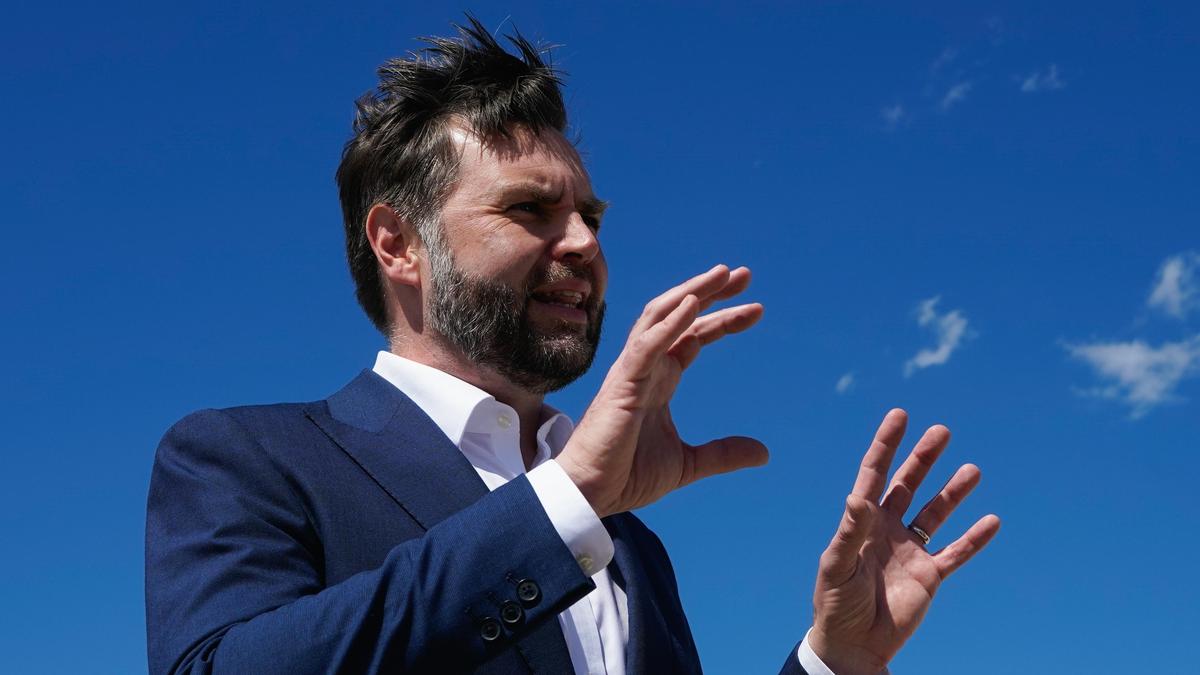

Vice President J.D. Vance speaks to reporters at Joint Base Andrews, Md., en route to Switzerland on June 20, 2026.
| Photo Credit: Reuters
U.S. Vice-President J.D. Vance, Iran’s Parliament Speaker Mohammad Bagher Ghalibaf and Pakistan’s Prime Minister Shehbaz Sharif were among the top leaders who reached Switzerland on Sunday (June 21, 2026) for high-level talks aimed at restoring peace in West Asia.
Mr. Vance arrived on Sunday morning (June 21), while other U.S. negotiators — including envoy Steve Witkoff and adviser Jared Kushner — were already there.
Also Read : West Asia war LIVE updates
“My understanding, talking to Jared and Steve this (Saturday) morning, is things are going well,” Mr. Vance told Fox News before departing.
The Iranian delegation is being led by Mr. Ghalibaf, according to the state-run IRNA news agency.
It further said in a report, “Foreign Minister Abbas Araghchi, Deputy Secretary of the Supreme National Security Council Ali Bagheri Kani, and Central Bank of Iran Governor Abdolnaser Hemmati are also part of the delegation.” Pakistan PM Sharif also landed in Zurich on Sunday (June 21), accompanied by Army chief Asim Munir and other delegates.

“Pakistan will continue to facilitate the process in its role as mediator, with a view to advancing the understandings reached under the Islamabad Memorandum of Understanding,” its Foreign Office said in a statement on Saturday (June 20, 2026).
IRNA also reported that a meeting between Mr. Araghchi and his Swiss counterpart Ignazio Cassis happened on Sunday (June 21).
Negotiators from Qatar will also participate in the meeting, according to an official statement.
U..S President Donald Trump and Iranian President Masoud Pezeshkian last week signed a Memorandum of Understanding (MoU), which marked the beginning of a 60-day negotiation window to restore peace in West Asia. Key mediator Pakistan signed the MoU as a guarantor.

The technical aspects of the negotiations were supposed to begin on Friday (June 19, 2026), but were delayed, primarily due to fresh rounds of firing between Israel and Iran-backed Hezbollah.
The aim of the high-level talks being held in Switzerland is to formally launch negotiations on curbing Tehran’s nuclear programme and advancing the fragile interim deal towards durable peace.
The signing of the MoU led to the reopening of the Strait of Hormuz – the waterway through which roughly one-fifth of the world’s energy supplies pass in normal times. However, Iran said on Saturday (June 20) that it has closed the Strait again, citing Israeli attack in Lebanon.
Mr. Vance said that the Gulf chokepoint remains open for shipping, while Mr. Trump issued a threat to impose American tolls in the crucial waterway if a final deal with Iran isn’t reached in 60 days.

The agreement signed by Mr. Trump and Iranian President Masoud Pezeshkian immediately allows Tehran to sell its oil freely and paves the way for Iran to tap into billions of dollars in assets that are currently frozen. It also calls for Iran to dilute its stockpile of highly enriched uranium, believed to be buried under nuclear sites that were targeted in U.S. strikes last summer.
The agreement says commercial vessels can pass through the Strait of Hormuz for 60 days without a charge, but does not preclude future fees imposed by Iran. Trump made his own threat on Saturday (June 20, 2026) to levy U.S. tolls on the strait if there is no deal with Iran in 60 days, insisting in a social media post that the money would be for “services rendered as the Guardian Angel to the countries of the West Asia.”
Further complicating matters, neither Israel nor Hezbollah are signatories to the deal between the U.S. and Iran, and Israeli Prime Minister Benjamin Netanyahu has vowed to keep his forces in southern Lebanon until any threat to Israel is eliminated. Hezbollah has refused to halt its attacks unless Israel commits to withdrawing from Lebanon.
Fighting between Israel and Hezbollah in the initial days after the agreement between the U.S. and Iran killed 47 people in Lebanon, as well as four Israeli soldiers.
Published – June 21, 2026 10:00 am IST
Leave a Reply