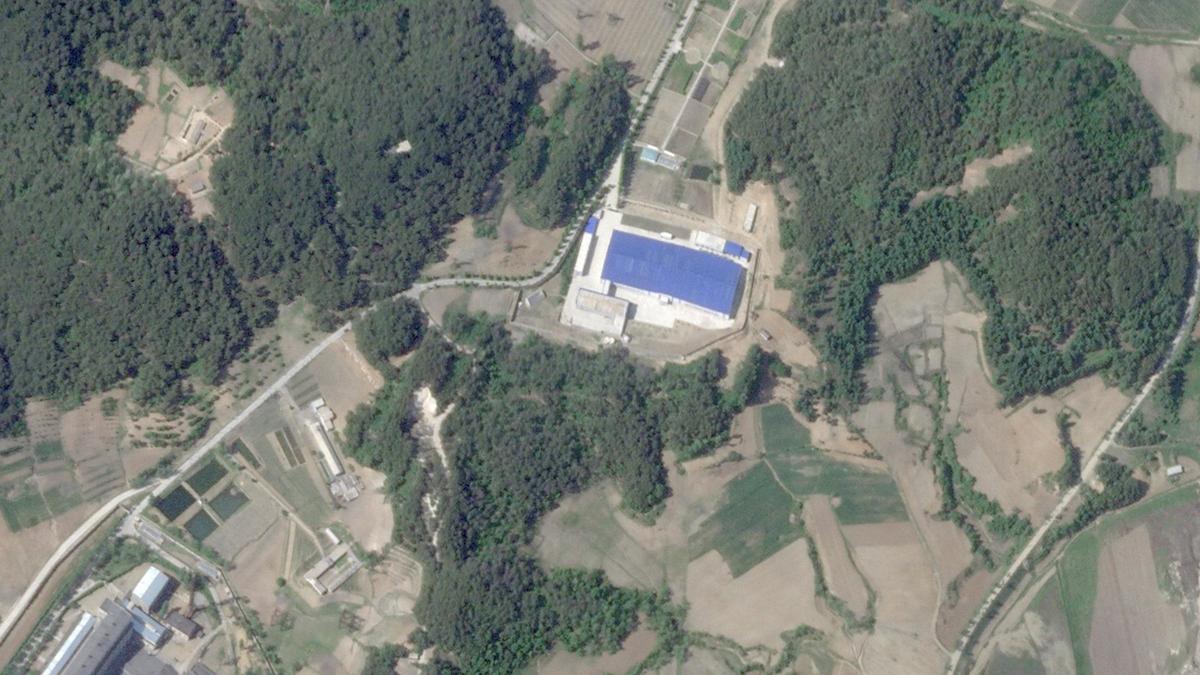

A satellite image shows a nuclear material production factory, in Yongbyon, North Korea on May 17, 2026.
| Photo Credit: Reuters
U.S. and South Korean officials discussed strengthening nuclear deterrence and readiness against North Korea’s growing weapons programme on Thursday (June 11, 2026), South Korea’s Defence Ministry said, at talks in Seoul under their Nuclear Consultative Group (NCG).
The meeting follows growing concern that North Korea is expanding its capacity to produce weapons-grade nuclear material, after state media showed leader Kim Jong Un inspecting a newly operating nuclear-material production plant and calling for an “exponential” expansion of the country’s nuclear forces.

The sixth meeting of the group was co-chaired by Kim Hong-cheol, Seoul’s Defence Policy Chief, and Robert Soofer, a senior U.S. Defence Official handling nuclear deterrence and weapons of mass destruction policy. Officials from Defence, Foreign Ministry and intelligence agencies also attended.
The Ministry said the two sides reviewed progress across the consultative group’s work, from information sharing and crisis procedures to joint drills and messaging, and explored ways to further bolster allied nuclear deterrence and readiness.
Last week, North Korea released images of Mr. Kim visiting a newly launched nuclear-material production facility and said he had reviewed plans to expand the country’s nuclear forces, in what analysts saw as a sign of Pyongyang’s intent to increase fissile-material output.

Hong Min, a senior researcher at the Korea Institute for National Unification, said North Korea’s output of weapons-grade nuclear material and its ability to mass-produce warheads could be higher than previously thought. That would be possible if several enrichment sites become fully operational, including Kangson, a new facility at Yongbyon, and a possible site in Kusong, he said.
The Wall Street Journal reported that North Korea’s uranium-enrichment capacity could rise by about 75% once the new Yongbyon facility reaches full production, citing analysis by Verification Research, Training and Information Centre (VERTIC), a London-based arms-control verification nonprofit.
The facility was estimated to contain more than 9,000 centrifuges capable of producing about 160 kg (353 lb) of highly enriched uranium a year, on top of an estimated previous annual capacity of about 215 kg, the report said.

Chinese President Xi Jinping also visited Pyongyang this week, his first trip there in seven years. Chinese and North Korean readouts emphasised stronger political, economic and cultural cooperation, but made no mention of denuclearisation.
The NCG was launched after the 2023 Washington Declaration, a U.S.-South Korean pact that included giving South Korea more insight into U.S. nuclear planning over any conflict with North Korea.
The talks come as Seoul is pursuing a transfer of wartime operational control from Washington, a process that has raised questions over how the allies would coordinate nuclear planning and conventional forces.
Published – June 11, 2026 06:18 pm IST
Leave a Reply