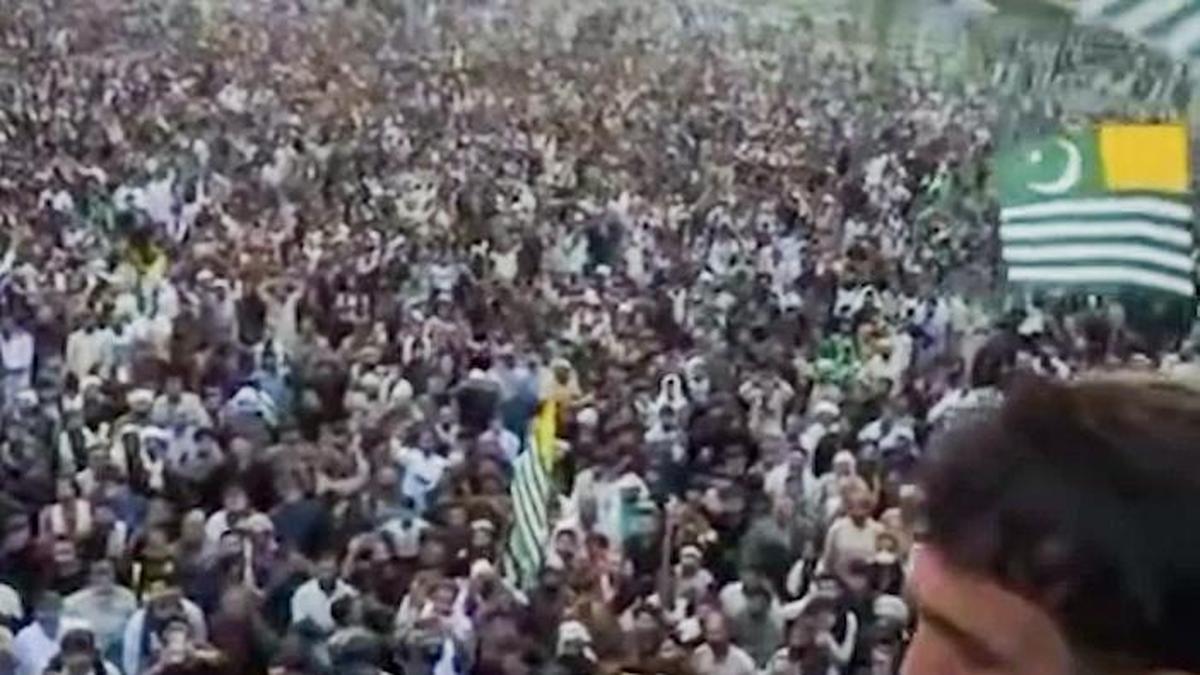
The story so far:
Pakistan-occupied Kashmir (PoK) is again in the throes of civilian unrest as protests for economic justice and equitable political representation rage across the region. The Joint Awami Action Committee (JAAC), which called for the protests, has since been banned by the regional government, for “engaging in terrorism”.

What is the JAAC and why did it call for protests?
The JAAC, an umbrella organisation of various civil society groups, trade bodies, students organisations and socio-religious groups based in PoK, was formed in 2023, out of protests against rising electricity tariffs and inflation. They brought out a 38-point Charter of Demands which included access to subsidised wheat flour, fair electricity pricing based on hydropower generation costs from the local Mangla dam, and the abolishment of the reservation of 12 seats for refugees in PoK’s Legislative Assembly.
While the JAAC was given assurances regarding electricity tariffs, their “non-fulfillment” led to wider protests. In May 2024, the JAAC called for a march to Muzaffarabad over their demands, which led to the police arresting around 70 members of the organisation. Outrage against the arrests resulted in clashes between civilians and the police, leaving at least four dead and hundreds injured. In the wake of this violence, Pakistan Prime Minister Shehbaz Sharif approved the grant of a $86.25 million subsidy programme.

In October 2025, protests again emerged due to a breakdown of talks between officials and the JAAC. The ensuing violence killed at least 10 people. The government then agreed to some demands which included providing compensation for those killed in the violence, releasing funds for the implementation of health cards, and issuing a grant of PKR 10 billion for the improvement of the electricity system.
While it was also decided that a high-powered committee comprising legal and constitutional experts would deliberate on the issue of members of the PoK Assembly, the central question remained unaddressed.
How did the situation escalate?
Elections to the regional government of PoK have been scheduled for July 27. The JAAC announced that they would take out a protest march to Muzaffarabad, calling for an end to the reservation of the 12 refugee seats, on June 9 — the same day on which the filing of nominations for the elections was to begin.
In an effort to nip the march in the bud, the regional authorities banned the JAAC under a 2014 anti-terrorism law and placed a bounty for its most prominent leaders. They said the organisation had acted in a manner “prejudicial to peace and security” of the state. This led to widespread protests in various cities, particularly Mirpur, Rawalakot and Muzaffarabad, with police personnel clashing with civilian protesters.

On June 8, at least 11 people, including four police officers, were killed and dozens injured when regional authorities opened fire on activists and protesters gathered in Rawalakot for the funeral of a local trade activist who had been killed during an earlier protest.
While the proscribed JAAC has called for strikes, leaving life paralysed in the streets of Muzaffarabad, many parts of the region continue to witness violent clashes, with reports indicating that the death toll has crossed 30.
Regional authorities have deployed paramilitary troops in the region to restore law and order and have also issued a strict travel advisory urging visitors to avoid travelling to the region. Reports also say that Internet in the region has been severely restricted.
Why has the reservation of refugees become a flashpoint?
The political question regarding the 12 reserved refugee seats is at the heart of the protests. The regional Assembly of the PoK has a total of 53 seats. Of these, 45 seats are directly elected by the public (33 are elected by the general public while 12 seats are reserved for refugees). The remaining eight seats are reserved (five for women, one for a technocrat, one for a religious scholar and one is a diaspora seat) and are filled via nominations after the general elections.
The 12 reserved seats are for communities who migrated to Pakistan from Jammu and Kashmir during Partition. Over the years, these groups have integrated into Pakistani cities and polity. In fact, most of these 12 seats have often been won by political parties such as the Pakistan Peoples Party or the Pakistan Tehreek-e-Insaf. As the journalist Luv Puri writes, “…the 12 refugee seats account for around 4.36 lakh registered voters, while the remaining 33 directly elected seats in PoK have around 33 lakh voters. In effect, one refugee vote cast from Pakistan carries electoral weight far greater than that of a voter residing in PoK”.
Pakistan maintains that PoK, or what it calls ‘Azad Jammu and Kashmir’, is an independent region with its own polity and that Pakistan supports its right to self-determination. At the same time, candidates who are elected to the regional Parliament have to sign loyalty oaths supporting the “cause of accession of the State of Jammu and Kashmir to Pakistan”. This has led to questions regarding the undue influence of Islamabad in the regional politics of PoK.
In a further setback to such regional demands, on June 7, the Supreme Court of PoK observed that the 12 legislative seats reserved for refugees are constitutionally protected and cannot be abolished through administrative or executive measures; only a constitutional amendment can fulfil the demand to abolish refugee representation.
How have the Indian and Pakistani governments reacted?
On June 9, India asked the international community to hold Pakistan responsible for the civilian killings and human rights abuses in PoK. “There are reports of severe police brutality in Pakistan Occupied Kashmir in which several protesters have been killed and many injured. We hope the international community will hold Pakistan accountable for its misdeeds and abuses,” said Ministry of External Affairs spokesperson Randhir Jaiswal during a press briefing. National Conference president Farooq Abdullah condemned the violence and demanded a probe by the United Nations into the incidents of atrocities.
Pakistan Foreign Office spokesperson Tahir Andrabi dismissed India’s statements “in their entirety” and went on to state that “it is untenable” for a country like India which has “consistently denied the people of Jammu and Kashmir their right to self-determination to claim concerns over the rights of Kashmiris.”
The unrest has also generated global outrage. Human rights groups such as Amnesty International stated that the regional administration’s sweeping crackdown on protests is a continuation of the “alarming deterioration of human rights in the region”.
On June 6, a group of nearly 30 British parliamentarians, in a letter to the U.K. Foreign Office, raised concerns over reports of communication disruptions, arrests, and “escalating tensions” in the PoK. They urged the British government to engage proactively and use diplomatic channels to encourage a peaceful de-escalation in the region.
Published – June 14, 2026 02:12 am IST
Leave a Reply