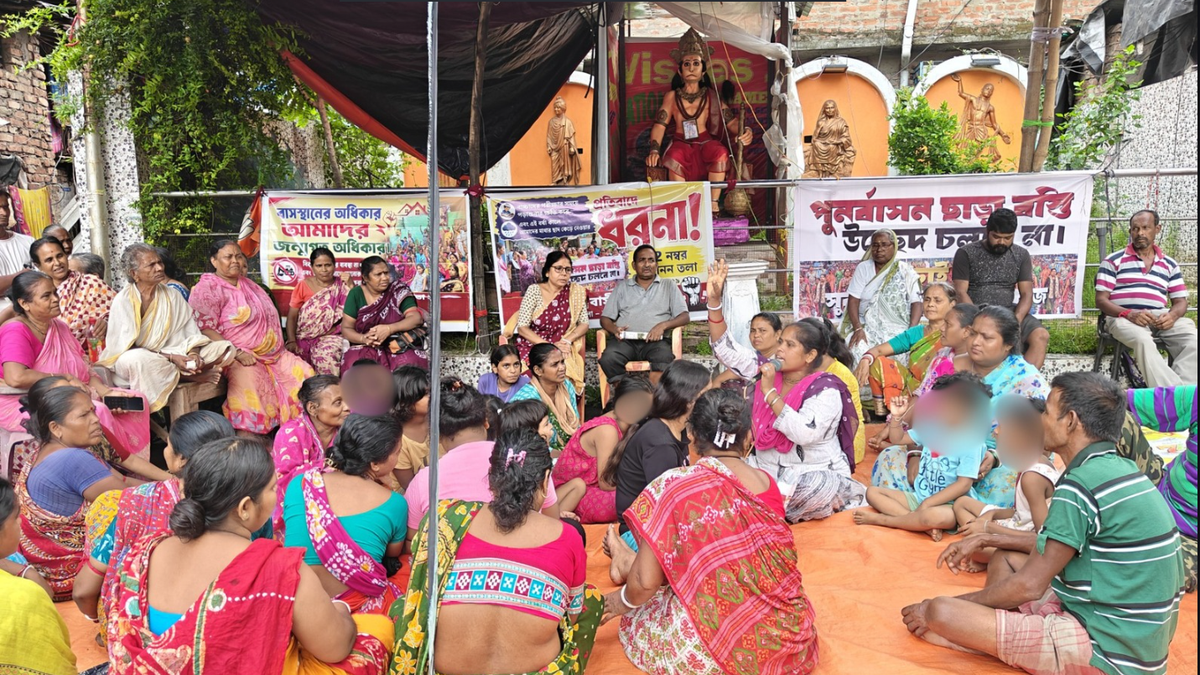

The women of the slum under the Dhakuria bridge in south Kolkata stage a sit-in demonstration against the eviction notice issued against them.
| Photo Credit: Shrabana Chatterjee
Women domestic workers of a south Kolkata slum in Dhakuria are pushing back against an eviction notice which does not ensure their rehabilitation. They have started a 24-hour sit-in demonstration under the Dhakuria flyover where they stay, since Tuesday (July 28, 2026).
At least 58 families live under the Dhakuria bridge, on one side of the road. Of these, 43 families have documents to prove their residence in the area. The slum dwellers on the other side of the bridge are yet to get an eviction notice, but many are counting days.
“They are coming in with police, central forces, police cars, and issuing notices, intimidating us late at night. Every time a police car comes by, everyone‘s face fills with fear, that they are minutes away from losing their home,” Sapna Tripathi, a member of the West Bengal Domestic Workers Union said.
Ms. Tripathi is not a resident of the area but comes every day to help the locals of the area organise and agitate, as well as assisting them with legal paperwork. She asked where these families would go overnight in the heavy monsoon rains of Bengal. They have also visited the “Janatar Darbar” (face-to-face interaction with Chief Minister Suvendu Adhikari to showcase people’s problems) but they failed to meet him. They also claim that they were turned away and told that the eviction is an administrative decision and the political party cannot do anything about it.
“Does anyone in this world like to live in slums and under bridges? Do we stay here voluntarily? We are forced to stay here because we are poor,” Ratna Parua, a local woman said. She said that every government office has told them that they have “orders from higher ups and their hands are tied.”
Locals have visited the local MLA Swapan Dasgupta’s office but failed to meet him. The local police or civic bodies have also not been of much help, according to the women. They have filed a case at the Calcutta High Court but were able to get a stay order on the eviction notice for just one day. They are waiting for the case to be heard in court again.
A young college going woman said that the anxiety of losing the roof over her head has affected her studies. “I submitted a project to college, and it was all wrong. I am not able to take this pressure; I am not able to concentrate on my studies. Just because we are poor, do we not deserve basic humanitarian consideration?” the girl said wishing to remain anonymous.
Many like her are spending sleepless nights and agitating and raising slogans to stop the feared bulldozer action. But they have refused to budge without their grievances being heard and proper rehabilitation.
Almost 90% of these women work as domestic helps in the nearby posh localities and high-rise buildings and the men work as daily wagers. They take turns sitting at the protest site, as every missed day of work means lost wages.
“Will the wheel of society turn without our labour? Will these houses which employ us function without us cooking, cleaning, driving their cars, working as their security? But when development and beautification of a place happens, why does it exclude us, the ones who keep society moving?” Bibha Naskar, secretary of the West Bengal Domestic Workers Union, who is also a resident of the area told The Hindu on Wednesday (July 29).
Ms. Naskar said that all of the residents of this locality voted for the new government and helped them come to power, but they are now feeling betrayed by the same administration they supported in the Assembly elections.
Since the Bharatiya Janta Party came to power in West Bengal on May 4, bulldozer demolitions and eviction of hawkers and slum dwellers across the State have been widespread. Human rights activists and opposition parties have also criticised the crackdown on the poorer sections of society.
Published – July 31, 2026 09:01 am IST
Leave a Reply